

Over the past several months, through the CCAE Learning Series, we have been working toward a very deliberate answer.
At its core, the CCAE Learning Series is an applied capacity-building program for civil society organizations (CSOs) working on cancer prevention and HPV vaccination. The goal is not information sharing for its own sake, but to help CSOs apply evidence- and behaviourally-informed approaches as they design, refine, and prepare to implement real-world interventions.
Importantly, this commitment does not stop at learning. CCAE is backing this approach with resources, providing grants and ongoing technical assistance because we believe in the capacity of these CSOs to implement what they have developed through the series. This is not a “train and hope” model. It is a learning-to-community-action pathway.
For the past five months, rather than one-way training, the core of the Learning Series has emphasized peer learning, reflection, and applied problem-solving.
Throughout the series, participants have worked to:
- Identify behavioural barriers and levers relevant to HPV vaccination in their communities
- Use behavioural science process as a practical design tool, not a theoretical add-on
- Translate insights into concrete communication and delivery strategies to address identified barriers
At key moments, experts shared data and effective practices related to HPV-related cancer burden, the science and safety of HPV vaccines, effective communication strategies, and implementation science. This content was intentionally sequenced to support decision-making through the behavioural science process and help CSO teams move from understanding the problem to critically shaping feasible interventions.
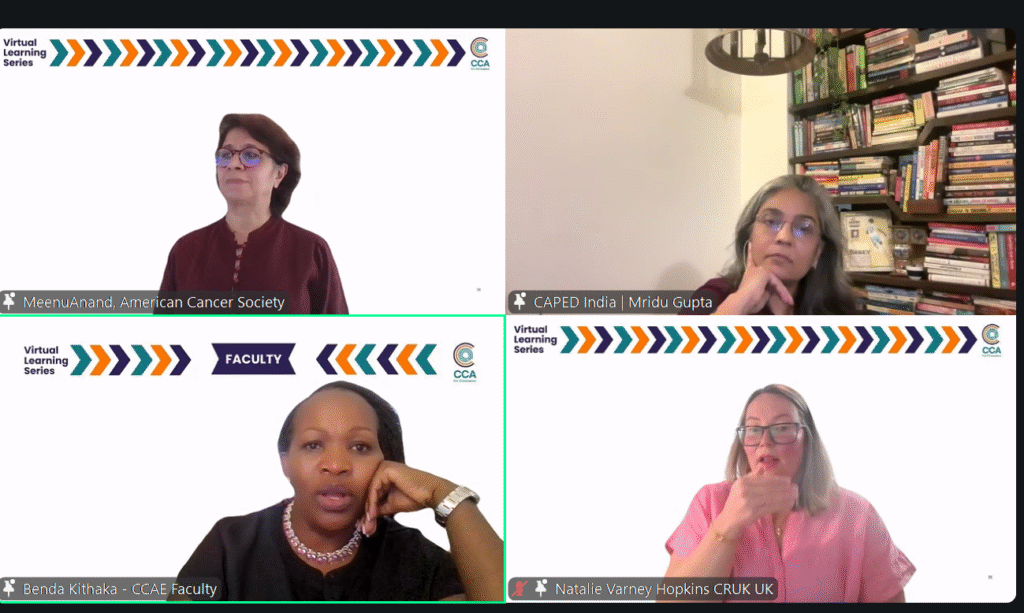
The past three public-facing webinars, including the final session on February 4th, marked an important milestone in our learning-to-community-action pathway. In these sessions, CCAE Learning Series cohort members shared the projects they have been developing. These were not polished success stories, but candid accounts of how CSO teams plan to apply evidence and behavioural insights to their public health challenges while navigating real-world constraints.
What stood out was the cohort’s successful application of the behaviour science process – developing clear problem definitions, using behavioural insights thoughtfully, and showing a willingness to adapt designs based on feedback and feasibility in context rather than relying on intuition and assumptions.
What comes next is critical.
Beginning in March, six CSOs will move into implementation of their interventions, supported not only by grants but by ongoing technical assistance for the next 12 months, including behavioural science support and monitoring and evaluation. We believe that pairing learning with hands-on implementation support helps close the gap between intention and action, not just for individuals, but for organisations working on cancer prevention.
If you missed the February 4th webinar or the previous showcase sessions, I invite you to watch them and follow along as this work continues. Recordings from Session 1 and Session 2 are now available, and we look forward to continuing this work as these projects move into implementation.
 January is Cervical Cancer Awareness Month, a time to reflect on the impact cervical cancer has on women, families, and communities around the world.